
Ejer Tech. (China) maoy usa ka negosyo nga gidumala sa teknolohiya, nga nalangkit sa R & D, paggama ug pagbaligya sa uga nga mga gabinet, tukmang mga kasangkapan sa laboratoryo ug ubang elektrikal nga kasangkapan. Ang hedkuwarter anaa sa Hangzhou, naglingkod duol sa tibuok - kalibotang hedkuwarter ni Alibaba. Adunay mga sanga sa tibuok nasod. Ang among mga produkto gibaligya ngadto sa kapin sa 100 ka nasod ug rehiyon. Ang among pangunang mga produkto kaylap nga gigamit diha sa natad sa mga industriya sa elektroniks, mga institusyon sa panukiduki, mga ahensiya sa gobyerno, mga industriya sa kemikal, industriya sa medikal ug ubb. Ang kalidad sa atong mga produkto malig - on ug kasaligan, busa gisaligan sa mga kustomer sa tibuok kalibotan.
0+

Rehiyon

0+

Mga tiggamiti

0+

Sertipikon

HABANG KAMO

EJER

Aplikasyong
Electronics, 5G IoT

Electronic chips, semiconductor, IC circuits, 5G IOT, AI, Electric Vehicles (EVs), wafers, Optikal nga mga sangkap, photovoltaics, mga lente sa kamera.

Mga Laboratorio

Ang tukmang mga instrumento, hinungdanong mga dokumento, pagpreserbar sa mga relikya sa kultura, mga reagent sa medisina, paggamit sa pagtudlo.

Photovoltaic ug bag - ong enere

Ang hustong mga instrumento, bag - ong mga chips sa enerhiya, mga lente, mga baterya, mga module sa komunikasyon, mga sensor, IC patch.

Mga produkto
Uga nga mga Gabinet
Uga nga mga Gabinet
Serye sa Incubator
Kwalipikasiya
ISO9001:2015
CE
RoHS
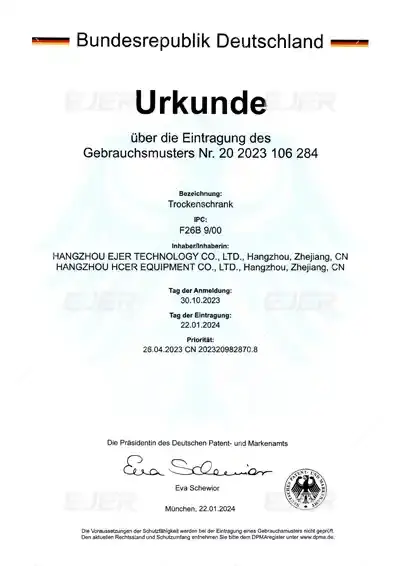
German Patent
WEEE
UK Patents
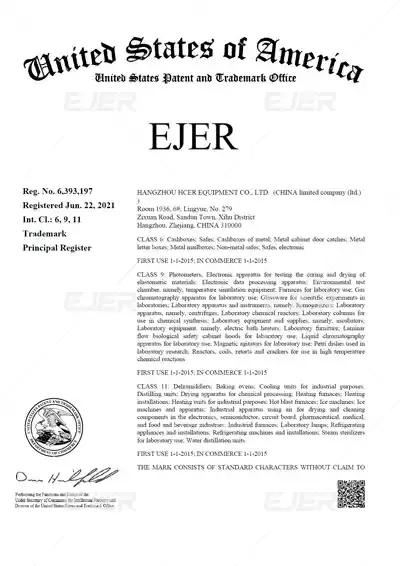
U.S. trademark
EU Trademark
Balita
EJER TECH Completes 100% Acquisition of Anhui Kabeni New Energy Co., Ltd.

EJER TECH Completes 100% Acquisition of Anhui Kabeni New Energy Co., Ltd.
— Subsidiary Rebranded as Wuhu EJER TECH Co., Ltd.
January 17, 2026 – Hangzhou, China – EJER TECH announced today the successful completion of its 100% acquisition of Anhui Kabeni New Energy Co., Ltd. The acquired company has been officially renamed Wuhu EJER TECH Co., Ltd., marking a strategic milestone in EJER TECH’s expansion into the new energy and intelligent manufacturing sectors.
The restructured entity, now a wholly owned subsidiary of EJER TECH, will retain its operational base in Wuhu, Anhui Province, and is set to play a pivotal role in advancing the group’s integrated capabilities across the Yangtze River Delta region.
Founded in 2010, EJER TECH is a nationally recognized technology-driven enterprise based in Hangzhou, specializing in IoT solutions, environmental monitoring instruments, smart manufacturing equipment, and Class II medical devices. In recent years, the company has accelerated its nationwide footprint with subsidiaries and offices in Shanghai, Zhengzhou, Hefei, Chengdu, and other key cities. The acquisition of Anhui Kabeni New Energy follows EJER TECH’s earlier full acquisition of Kabeni Electronic Equipment (Suzhou) Co., Ltd. in 2025, underscoring its strategic focus on consolidating core technologies and industrial assets under the “Kabeni” ecosystem.
Wuhu EJER TECH Co., Ltd. will concentrate on R&D and integration of new energy equipment and intelligent control systems. Leveraging EJER TECH’s proprietary “EJER Cloud” IoT platform, the subsidiary aims to deliver end-to-end solutions for data acquisition, remote operations, and energy efficiency management tailored to new energy applications.
“Wuhu is a critical hub for new energy and advanced manufacturing in western Yangtze River Delta,” said a company spokesperson. “This integration strengthens our ability to offer seamless, intelligent solutions—from R&D to deployment—supporting China’s broader decarbonization goals.”
Industry observers note that this move reflects EJER TECH’s dual-track strategy of technological innovation and strategic investment, positioning the company at the forefront of the convergence between smart infrastructure and clean energy.
Looking ahead, EJER TECH remains committed to its mission of “technology-driven growth and innovation-led development,” with plans to further expand its global presence and provide reliable equipment and professional services to universities, research institutions, environmental protection agencies, and the semiconductor manufacturing industry.

Global Semiconductor Market Poised for Strategic Growth in 2025 Amid AI Boom and Geopolitical Shifts

The global semiconductor market is entering a pivotal phase in 2025, driven by surging demand for artificial intelligence (AI), the expansion of edge computing, and sustained investments in electric vehicles (EVs) and 5G infrastructure. According to recent industry reports, the market is projected to grow at a compound annual growth rate (CAGR) of 8.5% over the next two years, reaching an estimated value of $720 billion by the end of 2025.
A key catalyst for this growth is the explosive adoption of AI technologies across data centers, consumer electronics, and industrial applications. High-performance computing (HPC) chips, particularly GPUs and AI accelerators, are experiencing unprecedented demand as companies race to deploy generative AI models and enhance automation capabilities. Industry leaders such as NVIDIA, AMD, and Intel are expanding production and R&D efforts to meet this demand, while a new wave of fabless startups is emerging to innovate in specialized AI silicon.
Meanwhile, the automotive semiconductor segment continues to gain momentum. With global EV sales surpassing 30 million units in 2025, the need for power management ICs, microcontrollers, and sensor technologies has intensified. Suppliers like NXP, Infineon, and STMicroelectronics are reporting strong order backlogs, signaling sustained growth in this vertical.
Geopolitical dynamics remain a critical factor shaping the industry landscape. The U.S.-China tech rivalry has prompted both nations to bolster domestic semiconductor manufacturing. The U.S. CHIPS Act and China’s renewed focus on self-reliance are driving significant capital investments in foundry capacity and R&D. However, supply chain fragmentation and export controls continue to pose challenges for global collaboration.
On the innovation front, advancements in advanced packaging (e.g., chiplets and 3D stacking) and the transition to next-generation process nodes—such as Intel’s 18A and TSMC’s 2nm—are enabling higher performance and energy efficiency. These technologies are expected to be critical in sustaining Moore’s Law in the post-3nm era.
Despite strong fundamentals, the sector faces risks, including potential overcapacity in mature-node chips, cyclical inventory adjustments, and macroeconomic uncertainties stemming from inflation and interest rate policies.
In conclusion, 2025 marks a transformative year for semiconductors, where technological innovation and strategic realignment are redefining global competitiveness.
This analysis reflects only personal opinion.